 Seamline
The Best AI Garment Inspection Tools for Fashion in 2026
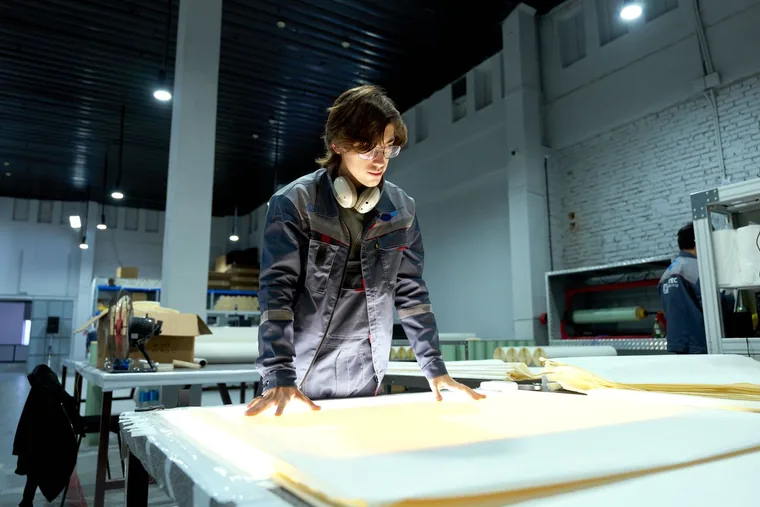
Fashion manufacturing has a quality problem, and it’s not for lack of effort.
QA teams work hard, spec sheets are detailed, and factories know the standards. But when the tools being used to enforce quality are a tape measure, a clipboard, and a spreadsheet, measurement variance is inevitable. It slips through on busy production days, it compounds across factories, and it eventually lands on your customer’s doorstep in the form of a garment that doesn’t fit.
AI garment inspection tools exist to close that gap. But not all of them are built the same way, for the same environments, or to the same standard of accuracy. This guide breaks down what to look for, what the leading approaches are, and how to evaluate which tool is right for your operation.
What Are AI Garment Inspection Tools?
AI garment inspection tools are software and hardware systems that use artificial intelligence, specifically computer vision and machine learning, to automate the measurement, analysis, and quality verification of garments during production or at the point of receiving.
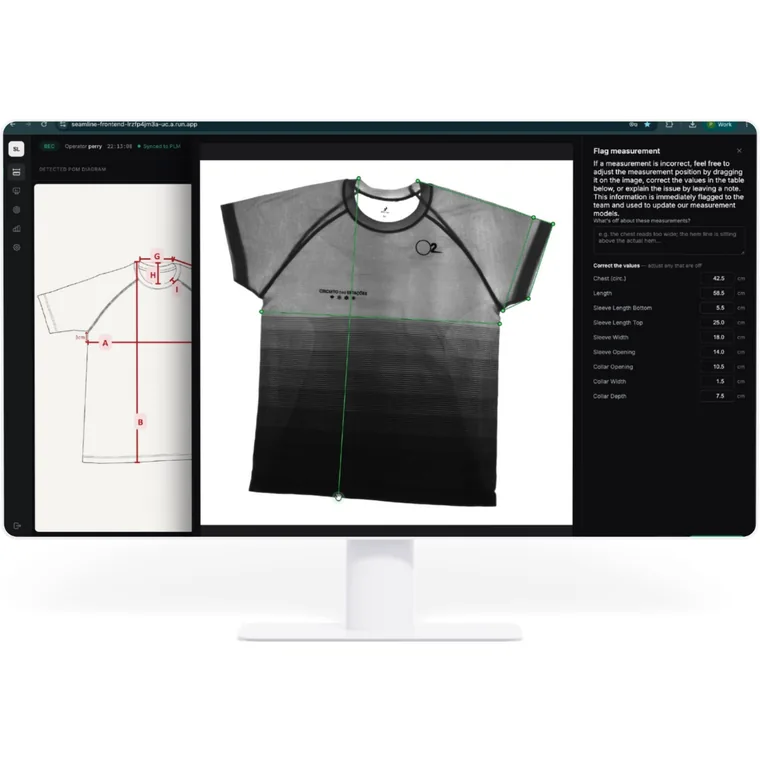
Rather than relying on a QA technician to manually measure each garment with a tape measure and record the result by hand, AI garment inspection tools capture a photograph or scan of the garment and use trained models to identify key measurement points, calculate dimensions, and compare results against a brand’s specification sheet, automatically and in seconds.
The best systems do this at a level of accuracy that meets or exceeds manual measurement, at a fraction of the time, and with full documentation of every result.
Why Fashion Brands and Manufacturers Are Investing in AI Garment Inspection
The business case for automated garment inspection is straightforward once you look at the numbers.
Fit-related issues account for approximately one in three fashion returns globally, a figure that represents hundreds of billions of dollars in annual losses across the industry. A significant portion of those returns trace back to measurement variance that manual QA failed to catch: a sleeve 1.2 centimeters too long, a chest width 0.8 centimeters too narrow, a hem that doesn’t match the spec. Small deviations that are invisible to a hurried QA team but very visible to the customer who ordered a size medium and received something that fits like a large.
Beyond returns, there is the cost of chargebacks from retail partners, rework at the factory level, third-party auditing fees, and the time QA teams spend on manual data entry rather than actual quality analysis.
AI garment inspection tools address all of these at the source by making measurement faster, more consistent, and more comprehensive than any manual process can achieve.
What to Look for in AI Garment Inspection Tools
Before comparing specific tools, it helps to know what criteria actually matter for enterprise fashion brands and manufacturers. Here is what to evaluate:
Measurement Accuracy The most important specification. Look for tools that can consistently measure to within 0.3 to 0.5 centimeters under production conditions. Tools that claim accuracy without publishing tolerance data should be pressed on this point. Accuracy also varies by garment type: a tool that performs well on structured menswear may struggle with stretch fabrics or complex intimate apparel constructions.
Points of Measure Customization Every brand has its own POMs. The best AI garment inspection tools are configured to your measurement specifications during onboarding, not to a generic default library that may not match your spec sheets. If a tool cannot adapt to your POMs, it cannot serve your actual QA process.
Speed Per Garment Time-to-measurement matters enormously at production scale. Tools that require multiple photos, complex setup, or lengthy processing times create their own bottlenecks. Look for systems that can process a garment in under ten seconds from photo capture to result output.
Integration with PLM and ERP Systems Measurement data is only useful if it flows into the systems your team already uses. AI garment inspection tools that require manual data export or re-entry into your PLM defeat much of the efficiency purpose. Look for direct API integration or native connectors to common PLM platforms.
Multi-Location Support For brands managing multiple factories or facilities, the ability to deploy a consistent QA standard across all locations, with centralized reporting and benchmarking, is critical. A tool that works well at one factory but cannot be standardized across your network is a partial solution at best.
Hardware Requirements Some AI garment inspection tools require expensive, proprietary scanning hardware. Others work with commercially available cameras and computing equipment. The latter is generally preferable for cost management and scalability, particularly when deploying across multiple factory locations.
Reporting and Documentation Every inspection result should be recorded, searchable, and exportable. Look for tools that produce clear pass/fail reports at the garment level, batch summaries, and deviation trend data over time. This documentation is essential for supplier accountability conversations and internal quality benchmarking.
The Main Categories of AI Garment Inspection Tools
The market for AI garment inspection technology is still developing, but the approaches fall into a few distinct categories.
1. Computer Vision Measurement Platforms
These are systems, like Seamline, that use high-resolution cameras and trained AI models to measure garments from photographs. The garment is placed on a flat surface or measurement station, a photo is taken, and the system identifies key measurement points and calculates dimensions automatically.
Best for: Factory floor QA, warehouse receiving inspection, pre-production sample verification, and any environment where consistent, high-volume garment measurement is the primary need.
Accuracy: The best systems in this category measure to within 0.3 centimeters, meeting or exceeding what is achievable through careful manual measurement.
Key advantages: Speed, consistency, scalability, and low hardware cost relative to alternative approaches. A single measurement station can process hundreds of garments per shift, with every result documented automatically.
What to watch for: Model performance across different garment types and fabric constructions. Computer vision models trained primarily on woven structured garments may not perform as well on stretch, sheer, or heavily textured fabrics without specific calibration.
2. 3D Body and Garment Scanning Systems
These systems use structured light, infrared scanning, or photogrammetry to create a three-dimensional model of a garment, from which measurements are derived.
Best for: High-precision bespoke and made-to-measure environments, luxury product development, and applications where three-dimensional form data (not just flat measurements) is required.
Accuracy: Very high under controlled conditions, but the hardware is expensive, the setup is complex, and throughput is significantly lower than photograph-based systems.
Key advantages: Exceptional accuracy for complex three-dimensional garment forms. Useful for product development as well as QA.
What to watch for: Cost. High-end 3D scanning systems can run tens of thousands of dollars per unit, making them impractical for routine production floor QA at scale. They are also slow relative to production volumes most manufacturers need to process.
3. Automated Inline Inspection Systems
These are conveyor-based or overhead camera systems installed directly on a production line, designed to inspect garments as they move through manufacturing rather than as a discrete QA step.
Best for: Very high-volume production environments where QA must happen at line speed without creating a separate inspection station.
Key advantages: True inline integration with no separate QA step required.
What to watch for: These systems are typically the most expensive to install and maintain, require significant factory floor modification, and are optimized for defect detection (holes, stains, seam failures) rather than dimensional measurement accuracy. For brands whose primary QA concern is measurement consistency against spec, a dedicated measurement platform like Seamline will generally deliver better results at lower cost.
4. Traditional QA Software with AI-Assisted Data Entry
These tools do not replace manual measurement. They use AI to assist with recording and organizing the measurements a human takes. Some use image recognition to pre-populate fields or flag obvious outliers.
Best for: Teams not yet ready to fully automate measurement, or environments where manual inspection is required for regulatory or contractual reasons.
Key advantages: Lower implementation barrier. Can improve consistency and documentation without requiring hardware investment.
What to watch for: The core limitation remains: measurement accuracy and speed are still constrained by the human taking the measurement. These tools reduce the administrative burden of manual QA but do not solve the fundamental consistency and throughput problems that fully automated garment inspection tools address.
How Seamline Compares
Seamline is a computer vision measurement platform built specifically for fashion brands, manufacturers, and QA teams who need fast, accurate, scalable automated garment inspection.
Accuracy: Consistent measurement to within 0.3 centimeters across a wide range of garment types and SKU categories.
Speed: Under six seconds from photo capture to measurement output, enabling teams to process dramatically more garments per shift than manual methods allow.
POM customization: Every Seamline deployment is configured to the client’s own Points of Measure during onboarding. Seamline learns your spec, not the other way around.
Hardware: The Seamline Workbench is built from commercially available components: a backlit light table, a high-resolution machine vision camera, and a Raspberry Pi computing unit. That keeps the hardware cost between $5,000 and $7,000 per station. This is a fraction of the cost of proprietary scanning systems and makes multi-location deployment financially practical.
Integration: Seamline integrates with most PLM and ERP systems, with measurement data flowing directly into the platforms your team already uses.
Multi-location support: Seamline is designed to standardize QA across multiple factories, with centralized reporting and factory performance benchmarking available at the brand level.
Reporting: Every garment receives a pass/fail report with individual measurement results, deviation data, and batch summaries, all exportable as PDF or CSV and shareable with suppliers, factories, and internal teams.
Questions to Ask Any AI Garment Inspection Vendor
Before committing to any AI garment inspection tool, ask these questions:
- What is your published measurement accuracy, and under what conditions was it validated?
- Can the system be configured to our specific Points of Measure, or does it use a fixed measurement library?
- How does the system perform on our specific garment types, particularly stretch fabrics, outerwear, or intimate apparel?
- What PLM or ERP systems do you integrate with natively?
- What does multi-location deployment look like, and how is QA data centralized?
- What are the total hardware costs per location, and who owns the hardware?
- What does onboarding look like, and how long until the system is calibrated and production-ready?
- What does the pilot or proof-of-concept process look like?
Any vendor that cannot answer these questions clearly and specifically is not yet ready for enterprise deployment.
The Bottom Line
AI garment inspection tools are no longer a future investment. They are a present competitive advantage. The brands and manufacturers who deploy them now will build measurement consistency, reduce returns, and free their QA teams to focus on decisions rather than data entry. Those who wait will continue absorbing the cost of variance that a tape measure and a spreadsheet were never designed to prevent.
The right tool depends on your garment types, production volume, factory footprint, and integration requirements. But for the vast majority of fashion brands and manufacturers looking to automate garment inspection at the production floor or warehouse level, a computer vision measurement platform offers the best combination of accuracy, speed, cost, and scalability available today.