 Seamline
The End of the Tape Measure
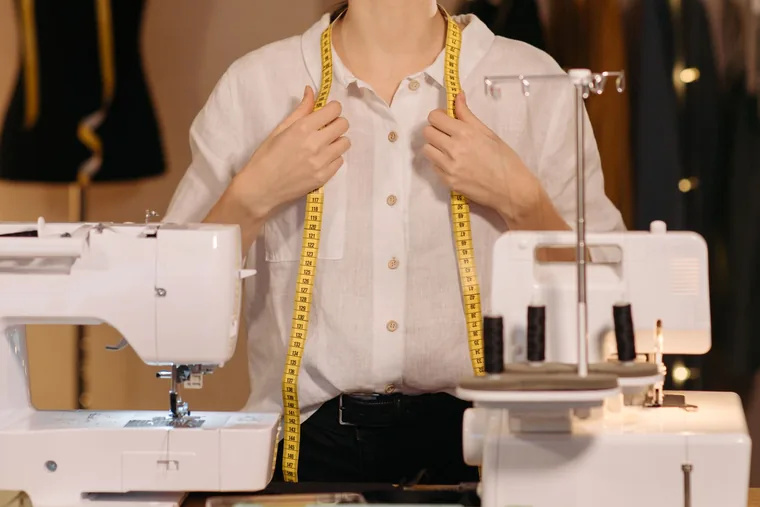
For decades, the tape measure has been the most trusted tool in a garment QA team’s arsenal. It’s familiar, portable, and costs almost nothing. It’s also slow, inconsistent, and completely unable to keep pace with the demands of modern fashion manufacturing.
Seamline was built to change that. It is AI garment measurement software purpose-built for the QA and technical teams who can’t afford to get sizing wrong.
Seamline: The Most Advanced Garment Measurement Technology Available
Seamline is an AI-powered garment measurement and quality assurance platform built for the technical teams, QA managers, and production specialists who are responsible for getting sizing right before a single garment reaches a customer.
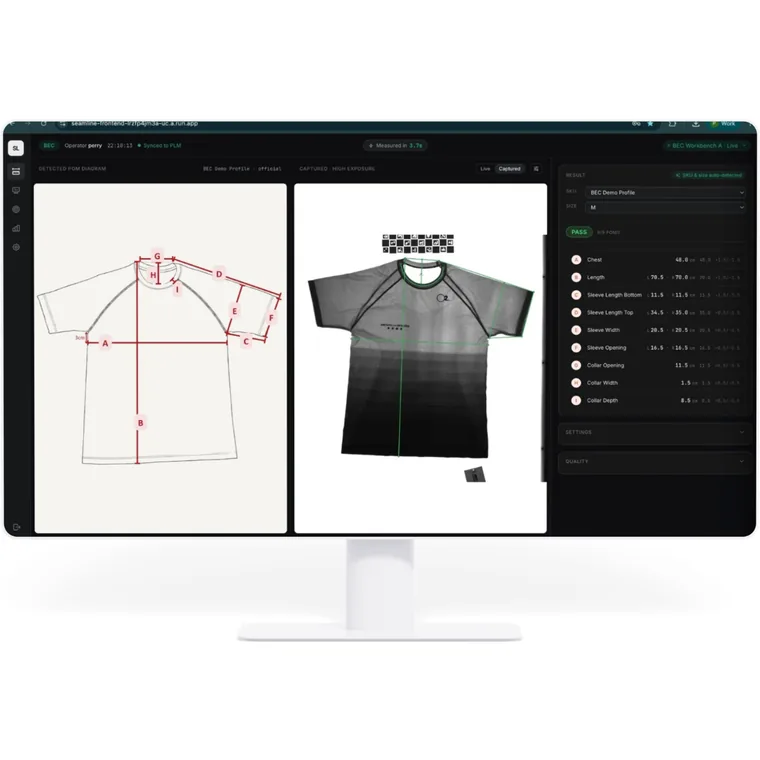
Unlike tools that simply organize manual measurement data, Seamline eliminates 75% of manual measurement. One flat-lay photo. One automated analysis. A complete, spec-matched QA report, delivered in seconds.
It is the most advanced AI garment measurement software available for factory and warehouse QA environments, and it was built from the ground up by the Seamline team, who have spent over a decade developing automated garment measuring systems for the fashion industry.
How Seamline’s AI Garment Measurement Software Works
Seamline is built around a deceptively simple idea: if a computer vision model can identify measurement points on a garment from a photograph, it can measure that garment faster, more consistently, and more accurately than a person with a tape measure ever could.
The process has four steps.
Step 1: Photograph A team member places a garment flat on the Seamline Workbench, a purpose-built photo station consisting of a backlit table, a high-resolution machine vision camera, and a mini-computing unit. One photo is taken. That’s the entire input required.
Step 2: Measure Seamline’s proprietary computer vision models analyze the photograph and automatically identify key measurement points across the garment, following your points of measure. Chest, shoulder width, sleeve length, waist, hem, inseam, neck opening, and more. Dimensions are calculated and verified to within 0.3 centimeters. No tape. No manual input. No data entry.
Step 3: Compare Every measurement is checked against the client’s own Points of Measure, uploaded directly into the Seamline platform during onboarding. Seamline compares each result against the agreed spec and tolerance for that SKU, automatically flagging any deviation that falls outside of range.
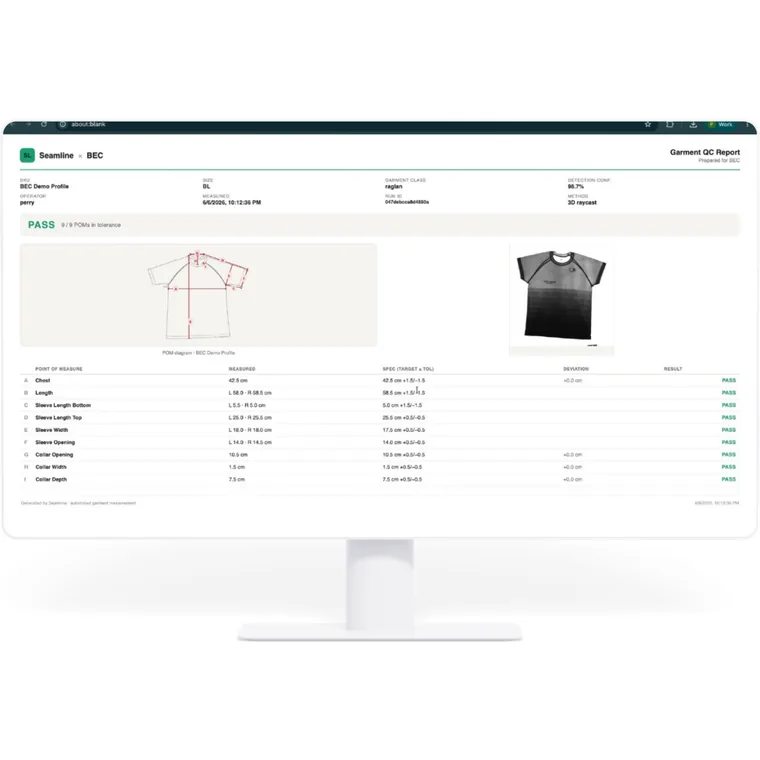
Step 4: Report The QA team receives an instant pass/fail report for every garment, complete with individual measurement results, deviation data, and a batch-level summary. Reports are exportable as PDF or CSV and shareable with factories, suppliers, and brand teams in a single click.
The entire process, from photo to report, takes seconds.
AI Versus Human Measuring: Why Technology Wins
This is not a knock on the QA professionals who have built their careers around getting sizing right. It is an acknowledgment of a simple truth: human measurement introduces variables that AI garment measurement software does not.
Consistency When a person measures a garment, the result depends on how tightly they pull the tape, where they place it, and whether they’re on their first garment of the day or their four hundredth. Seamline applies the same algorithm, the same reference points, and the same tolerance logic to every single garment it evaluates, without fatigue, distraction, or variation.
Speed A skilled QA technician can measure a garment manually in three to five minutes. Seamline’s automated garment measuring does it in seconds. At scale, the difference is not marginal. It’s transformational. A team that once processed fifty garments in a shift can process hundreds.
Objectivity Manual QA involves judgment calls. Is this seam close enough? Does this sleeve fall within tolerance? Seamline removes subjectivity entirely. Every result is calculated, documented, and traceable. There is no ambiguity, no disagreement between team members, and no room for a measurement to be waved through on a busy day.
Documentation Every Seamline measurement is permanently recorded. Teams have a searchable, auditable history of every garment ever evaluated, something a tape measure and a spreadsheet can never fully replicate.
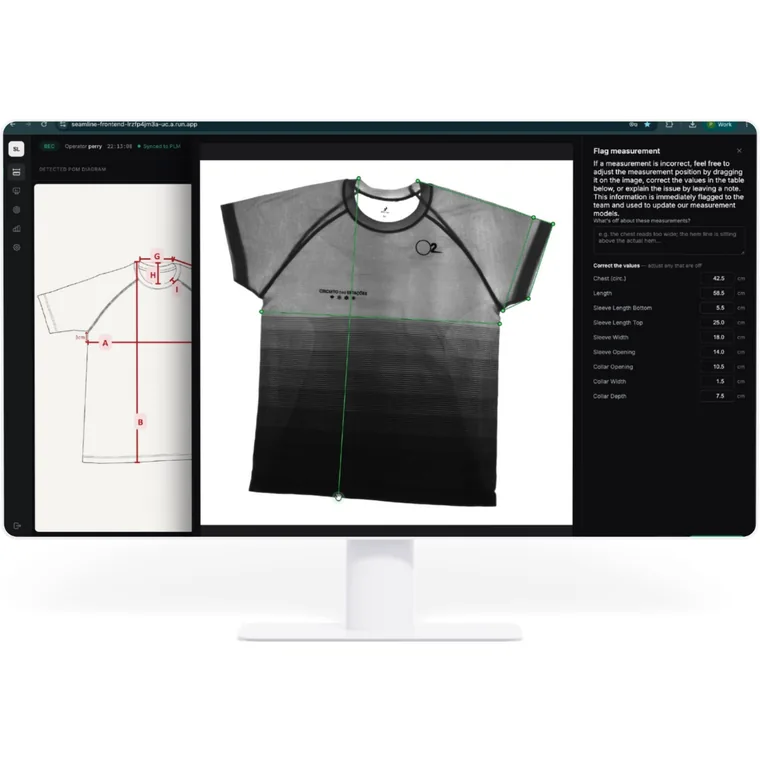
Accuracy Seamline’s machine learning models deliver garment measurement accuracy to within 0.3 centimeters, a level of precision that is difficult to achieve consistently by hand, particularly across large production volumes, multiple operators, or complex garment constructions.
Standardizing Garment QA Across Multiple Factories
One of the most persistent challenges in fashion production is measurement consistency across a global manufacturing network. A brand may work with factories across multiple countries, each with its own QA culture, team experience level, and interpretation of the brand’s spec sheets. The result is variance: garments that measure differently from factory to factory, even when made to the same spec.
Seamline solves this at the source.
Because Seamline is configured to each brand’s own Points of Measure during onboarding, every factory using the platform is evaluating garments against the exact same benchmark. There is no interpretation, no translation loss, and no difference in how a measurement is taken in Sri Lanka versus Vietnam versus Mexico. The algorithm is the algorithm. The spec is the spec.
This matters enormously for brands managing multi-factory production networks. For the first time, a QA manager at brand headquarters has access to consistent, comparable measurement data across every facility in their supply chain, enabling true factory performance benchmarking, informed supplier conversations, and data-driven decisions about where to concentrate quality investment.
Fewer Errors. Fewer Returns. Lower Costs.
The cost of a measurement error in fashion is not just the price of remaking the garment. It is the downstream cost of a return, a chargeback, a customer complaint, a damaged brand reputation, and a supplier dispute that takes weeks to resolve.
Seamline’s AI quality control for fashion manufacturing attacks measurement error at its root.
By catching deviations at the sample and pre-production stage, when a fix costs a fraction of what it costs post-production, Seamline enables QA teams to stop errors before they compound. A sleeve that is 1.2 centimeters too long is a five-minute conversation with a factory at the sample stage. At bulk production, that same error across five thousand units is a logistics and financial nightmare.
In the bulk and post-production phase, Seamline gives teams the ability to catch issues before goods are packed, shipped, or received at a 3PL, the last point at which intervention is still affordable. Brands using AI garment measurement software consistently report a measurable reduction in fit-related returns, which account for one in three fashion returns globally and represent billions of dollars in annual losses across the industry.
QA More Garments. With the Same Team.
Perhaps the most immediate impact of Seamline for most QA teams is not accuracy or standardization. It is capacity.
Manual measurement is a bottleneck. There are only so many hours in a shift, only so many hands on a team, and only so many garments that can be physically measured before production deadlines force a choice between thoroughness and speed. Most brands QA a sample of their production, not all of it, because measuring everything is simply not feasible at manual speed.
Seamline’s automated garment measuring changes that calculation entirely.
When measurement takes seconds rather than minutes, the same QA team can evaluate dramatically more garments in the same timeframe. Spot-check rates go up. Inline QA becomes viable. Full batch verification, previously reserved for only the highest-risk SKUs, becomes a realistic standard operating procedure.
The result is not just fewer errors slipping through. It is a fundamentally more confident production process, where brands and manufacturers can enter a final QA review knowing that their data is complete, consistent, and trustworthy.
Built for the Teams Who Make Quality Happen
Seamline was not built for the boardroom. It was built for the QA manager running a factory floor in the middle of a bulk production cycle, for the technical designer trying to reconcile conflicting measurements on a pre-production sample, and for the brand QA director who needs reliable data from six factories across three continents.
It is web-based, device-agnostic, and requires no software installation. It integrates with most PLM systems. It is configured to your Points of Measure, not ours. And Seamline’s AI garment measurement software is available to brands of every size, from emerging labels running their first production run to global manufacturers managing thousands of SKUs across a worldwide supply chain.
The tape measure had a good run. Seamline is what comes next.