 Seamline
The True Cost of Manual Garment QA

There is a number that almost no fashion manufacturer knows with precision, and it may be one of the most important numbers in their operation.
It is the total annual cost of manual garment quality assurance.
Not the cost of the QA team’s salaries. Not the budget line for third-party auditors. The total cost, including every rework order, every chargeback, every return, every brand audit failure, every shipment delay, every dispute with a factory, and every customer who bought the wrong size because a measurement was missed by two centimeters on a busy Tuesday afternoon.
When you add all of that up, the number is almost always significantly larger than anyone expected. And the root cause, more often than not, is measurement variance that manual QA failed to catch.
This article is about what manual garment QA is actually costing you, not just in salaries and auditor fees, but in every downstream consequence of a measurement that slipped through.
What We Mean by Manual Garment QA
Manual garment QA refers to the process of measuring garments by hand, using tape measures, measurement boards, or similar tools, and recording the results manually, typically in spreadsheets or PLM systems.

It is how garment quality assurance has been done for decades. And for most of that time, it was the only option available.
The problem is not that manual QA doesn’t work at all. Experienced QA technicians do catch real problems. The problem is that it doesn’t work consistently, at scale, across multiple operators, multiple shifts, multiple factories, or multiple production runs. And in modern fashion manufacturing, inconsistency at any of those levels has a cost.
The Direct Costs of Manual Garment QA
Let’s start with the costs that appear on a budget somewhere: the ones that are visible, even if they’re not always fully attributed to QA.
1. QA Labor
A QA technician measuring garments manually takes approximately three to five minutes per piece under normal conditions. In a high-volume production environment, that rate creates a hard ceiling on how many garments can be inspected in a shift. Most manufacturers respond by inspecting a sample of production rather than all of it, typically following AQL (Acceptable Quality Level) sampling standards.
AQL sampling is a statistically sound approach, but it means that a significant proportion of production is never individually inspected. Defects that fall below the AQL threshold will be approved for shipment. That’s not a failure of the QA team. It’s a structural limitation of manual inspection at scale.
For a manufacturer running 50,000 garments per month, even a 1% defect rate that slips through AQL sampling represents 500 garments with potential measurement issues reaching customers or retail partners.
2. Third-Party Auditing Fees
Many manufacturers, particularly those supplying major global brands, engage third-party inspection firms such as SGS, Bureau Veritas, or Intertek to conduct independent QA audits. These firms provide an important layer of compliance documentation but come at significant cost, typically ranging from several hundred to several thousand dollars per audit depending on scope, location, and garment type.
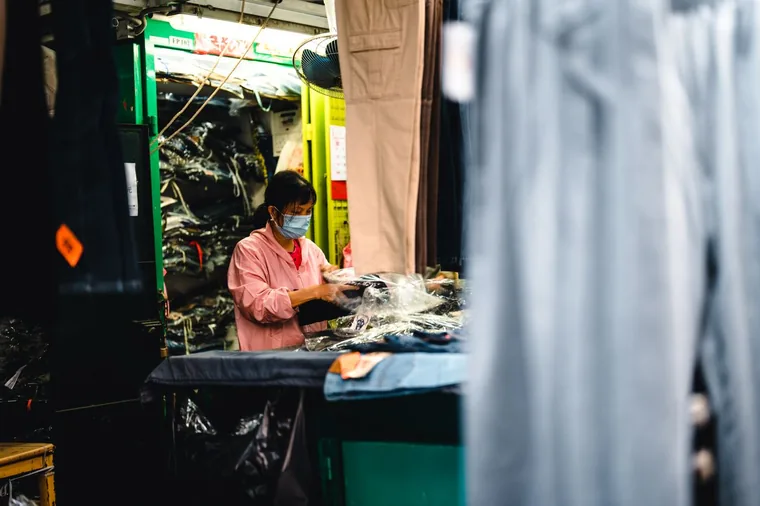
For a mid-to-large manufacturer with multiple factories and brand clients, annual third-party auditing costs can reach $40,000 to $80,000 or more. This is a real line item that appears directly in operations budgets, and it exists in large part because manual in-house QA cannot provide the documented, traceable measurement records that brand partners demand.
3. Rework Costs
When a measurement problem is caught, either by the QA team, by the third-party auditor, or by the brand client during pre-production approval, the cost of correction depends entirely on when it is caught.
Caught at the sample stage: the cost is a revised sample, some additional lead time, and a conversation with the factory. Expensive in time, manageable in money.
Caught at the pre-production stage: the cost rises. Patterns may need to be corrected, cut files revised, and bulk production delayed. Depending on the complexity of the garment and the size of the production run, this can run to thousands of dollars in rework and lost production time.
Caught at bulk production: the cost is at its highest. Correcting a measurement problem across thousands of cut and sewn garments may require partial rework, full reproduction, or in the worst cases, scrapping an entire production run. The financial impact can be significant, and the timeline impact can be severe enough to miss a seasonal delivery window entirely.
The pattern is consistent: the later a measurement problem is caught, the more expensive it is to fix. And manual QA, with its inherent rate limitations, catches fewer problems earlier, which means more problems surface later.
The Hidden Costs of Manual Garment QA
The direct costs above at least have a chance of appearing in a budget or a post-season review. The hidden costs are more insidious. They erode margin and brand relationships quietly, over time, without a clear attribution to QA.
4. Chargebacks From Retail Partners
Fashion brands that sell through wholesale channels (department stores, specialty retailers, and major retail chains) typically include chargeback provisions in their vendor agreements. A shipment that arrives with measurement deviations outside agreed tolerances can trigger a chargeback against the manufacturer, reducing the invoice value and in some cases requiring remediation at the manufacturer’s cost.
Chargeback rates vary widely by retailer and relationship, but for manufacturers supplying demanding brands like Zara, PVH, Marks & Spencer, or Target, measurement-related chargebacks represent a real and recurring cost. Even a 1 to 2% chargeback rate on a $2 million annual shipment volume represents $20,000 to $40,000 in direct financial impact.
The harder cost to quantify is the relationship damage. A pattern of chargebacks, even small ones, signals to a brand partner that a manufacturer’s QA process cannot be trusted. That signal directly affects which factories receive future orders, and which factories are phased out of supplier networks when brands consolidate.
5. Fit-Related Returns
For brands that sell direct-to-consumer, whether through their own ecommerce site, a marketplace, or a flagship retail environment, fit-related returns are one of the most significant margin killers in the business.
Approximately one in three fashion returns is driven by fit or sizing issues. Globally, fashion returns represent hundreds of billions of dollars in annual losses when reverse logistics, processing, restocking, and margin erosion are combined.
Not all fit-related returns trace back to measurement variance in production. Some are the result of size inconsistency in labeling, or a mismatch between how customers interpret sizing and how garments are actually cut. But a meaningful proportion, particularly for brands that have invested in clear, specific size guides, do trace back to garments that were simply not made to specification.

When a chest width is off by 1.5 centimeters, a sleeve is 2 centimeters longer than the spec, or a waist measurement doesn’t match the labeled size, the customer experience is a garment that doesn’t fit. And in an era of free returns and aggressive return policies, the cost of that experience lands directly on the brand, and indirectly on the manufacturer whose production caused it.
6. Brand Relationship Damage
This is the hardest cost to quantify and the most consequential in the long run.
Fashion brands, particularly large ones, invest enormous resources in building and maintaining their supplier networks. They conduct annual factory assessments, quality audits, and performance reviews. They track defect rates, chargeback rates, and on-time delivery performance. They use this data to make decisions about which factories to grow their business with and which to phase out.
A manufacturer whose QA data is inconsistent, undocumented, or unreliable is not just a QA problem. They are a business risk. And brand procurement teams, under pressure to deliver consistent product to demanding retail partners and end consumers, do not take business risk lightly.
The manufacturers who thrive in a long-term brand relationship are the ones who can demonstrate consistent, documented quality performance. The ones who struggle are the ones who cannot, regardless of how good their production capabilities are in other areas.
The Operator Variance Problem
One aspect of manual QA cost that rarely gets discussed explicitly is operator variance: the difference in measurement results between different QA technicians measuring the same garment.
In any real-world QA environment, different operators will produce different measurements. The variation is not negligence. It is a fundamental characteristic of human measurement. How tightly a technician pulls a tape measure, where exactly they place the tape relative to a seam, whether they measure on the inside or outside of a hem, how they handle stretch fabrics: all of these introduce variation.
In controlled studies of garment measurement, inter-operator variance of 1 to 3 centimeters on the same garment is not unusual. For garments with tight tolerances (technical sportswear, fitted bodywear, or children’s clothing), this level of variance can be the difference between a pass and a fail.
The practical consequence is that QA results in a manual environment are partly a function of who is doing the measuring, not just what is being measured. This makes it very difficult to build a reliable quality record, to benchmark performance accurately, or to have a meaningful conversation with a factory about specific measurement deviations.
The Compounding Effect
Each of the costs described above has its own financial footprint. But the real damage from manual QA inefficiency is not any single cost in isolation. It is the compounding effect of multiple costs occurring simultaneously, consistently, over time.
A manufacturer who is spending $50,000 per year on third-party auditing, absorbing $30,000 in annual chargebacks, carrying $40,000 in annualized rework costs, and losing 2 to 3% of revenue to fit-related returns is not facing a QA problem. They are facing a competitive disadvantage, one that erodes margin, strains brand relationships, and limits the ability to win new business from quality-focused brand partners.
And because the individual costs are distributed across multiple budget lines (operations, logistics, customer service, account management), the total is rarely calculated in a single place. It exists in the aggregate, silently, across the financial statements.
What the Alternative Looks Like
Automated garment measurement, using computer vision and AI to measure garments from a single photograph, does not eliminate the need for QA. What it does is change the cost structure of QA dramatically.
When a Seamline Workbench measures a garment in four seconds and produces a documented, spec-matched QA report automatically, several things happen simultaneously:
The throughput ceiling disappears. The same QA team can evaluate dramatically more garments in the same time, without adding headcount. AQL sampling becomes a choice rather than a necessity.
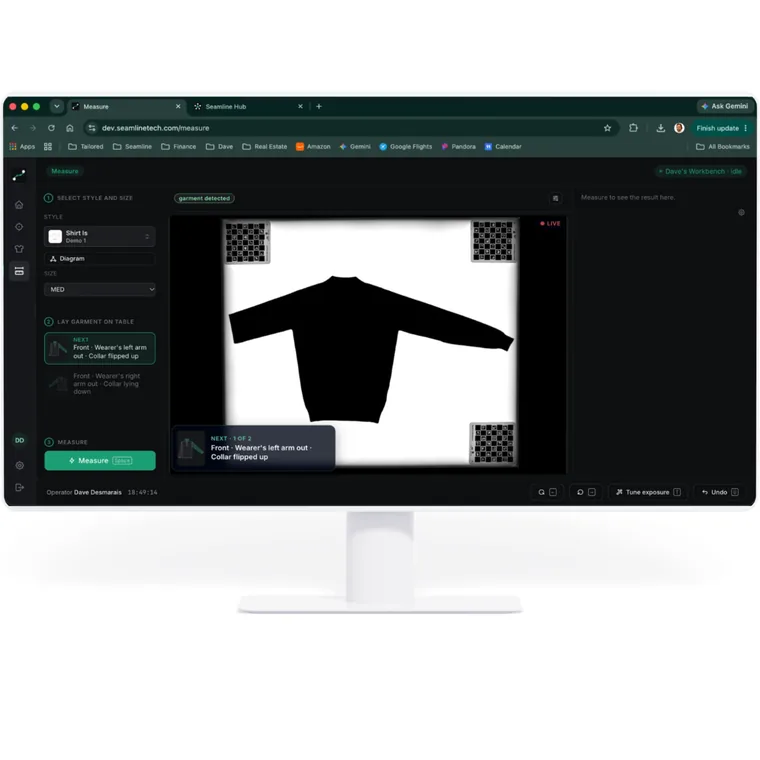
Operator variance is eliminated. Every garment is measured by the same algorithm, against the same reference points, with the same tolerance logic applied consistently. The result is not dependent on who is on shift.
Documentation is automatic. Every measurement is recorded, time-stamped, and exportable. The audit trail that third-party inspection firms charge to create is generated as a natural byproduct of the QA process itself.
Problems are caught earlier. When measurement verification is fast enough to run at the pre-production stage and the inline stage, not just the final inspection, deviations are caught when the cost of correction is lowest, not after thousands of units have been produced.
The financial impact varies by operation, but the direction is consistent: lower rework costs, fewer chargebacks, reduced reliance on third-party auditing, and a stronger position in brand partner conversations.
Calculating Your Own Manual QA Cost
The exercise worth doing before any technology evaluation is to attempt a full calculation of what manual QA is costing your operation today. The categories to include:
Direct costs:
- QA labor cost (hours × wage, for all QA-related measurement activity)
- Third-party auditing and inspection fees
- Rework costs attributable to measurement issues (by stage: sample, pre-production, bulk)
Indirect costs:
- Chargebacks attributable to measurement deviation
- Returns attributable to fit or measurement variance
- Cost of QA-related shipment delays
- Time spent on supplier disputes related to measurement disagreements
Relationship costs (harder to quantify, worth estimating):
- Orders lost or not awarded due to QA concerns from brand partners
- Cost of maintaining brand approval status with multiple clients
- Margin pressure attributable to QA performance perception
For most mid-size manufacturers, this exercise produces a number that is meaningfully larger than the QA department budget alone. For larger operations with multiple factories and brand clients, it can be significantly larger.
That number is the baseline against which any QA technology investment should be evaluated. Not against the cost of the technology itself, but against the cost of the problem the technology solves.
The Bottom Line
Manual garment QA has served the fashion industry for decades. It will continue to have a role in garment production for years to come. But the idea that it is a cost-neutral or low-cost approach to quality assurance is a misconception that becomes more expensive with every passing season.
The real cost of manual QA is not the tape measures and the clipboards. It is the measurement variance that slips through, the chargebacks that arrive at the end of the quarter, the rework orders that delay a season, the brand relationships that quietly erode, and the return parcels that arrive back at the warehouse having already cost you twice: once to make and once to take back.
Calculating that cost clearly is the first step toward addressing it. The second step is understanding what the alternative looks like.